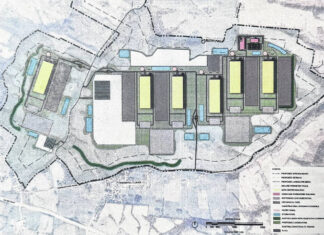

The data center zoning text amendment proposal.
Lauren Tatman/The Ledger Independent
A set of public hearings has officially been scheduled for the purpose of discussing a proposed text amendment concerning data centers.
On Wednesday, Nov. 5, the Maysville-Mason County Joint Planning Commission (JPC) met to discuss a proposed text amendment to the Comprehensive Plan regarding data centers. The amendment arrives on the heels of ongoing discussions concerning a potential incoming data center project in Mason County.
During Wednesday’s meeting, JPC Member Michael Parker stated that the commission is “trying to position (itself) to create a proposal that was best in class, or near the top of best in class.”
He then asked how this text amendment compares to others that are similar in size and scope.
Maysville’s Planning and Zoning Administrator, George Larger III, responded, “We did a little bit of comparing some of the biggies in this, such as setbacks, height restrictions… noise.”
He further explained that ordinances from the City of Maysville were used as models for the text amendment, noting that certain aspects such as noise are regulated in the city, but not the county.
“These numbers were really based on what was in the city, and I figured what’s good for the city is good for the county, since lots are a lot smaller,” Larger stated. “Really, when you compare all the numbers in some of the other places that have passed regulations in Kentucky, it’s kind of all over the map. But I used my best judgment, we used our best judgments. I really actually utilized a lot of what was in the zoning code for the city for a lot of things.”
Parker then asked if there was an expert who could examine the amendment and determine whether or not it was below standard. Larger answered by asking whether members of the JPC would want to hear from an expert before the main public hearing.
Michael Clarke, counsel representative for the JPC, stated that there is an expert who is retained by Mason County and will provide information and be subject to questioning.
“It makes sense to me to do that at a separate public hearing for the sole and limited purpose of the Planning Commission; hearing from this expert, asking questions of this expert, and also opening this expert up to cross-examination from people who have interest in the amendment to the text ordinance,” Clarke stated. “It’s a way to kind of isolate and have its own individual hearing where you can put your mind just on that issue, as opposed to hearing what the public has to say.”
Clarke recommended that the JPC hear from the public before the expert, but conceded that, due to logistics, it may be easier to hear from the expert first.
JPC Chair David Reed responded, explaining that they do not know which questions to ask and that receiving an overview from someone else would give them a better chance of understanding where the public is coming from.
JPC Member John Hutchings then asked what criteria were used to vet the expert.
Mason County Judge Executive Owen McNeill, who was in attendance at the meeting, introduced guests, including Eastern Kentucky Power Cooperative (EKPC) members and Andy Schall with Kimley-Horn, the expert Mason County retained.
According to McNeill, Kimley-Horn has offices in nearly 35 to 40 states and focuses on “a myriad of industrial and commercial sighting entities.”
“They do have a specialized division in technology campuses and data centers. Chairman Reed and I did a call with Mr. Schall, several of his counterparts,” McNeill stated.
Schall stated that he is based out of Columbus, Ohio, but works across the United States and is a licensed civil engineer.
“As a firm, Kimley-Horn, we’ve been involved in — I’ll say hundreds, but it’s probably approaching 1,000 now — data centers. Now, that’s not campuses, that’s data centers, so there could be more than one data center on a campus,” Schall stated. “Everything from the small five, 10-acre sites up to the many thousands of acres. In Columbus, the team I lead, we’ve probably done, I’ll say 30, 35, but again, campuses in the Columbus area.”
Reed noted that when he talked to McNeill and Schall, he told them that they were interested in what pitfalls were associated with data centers and how the system works from start to finish.
“He’s an independent consultant based on his expertise,” Reed said.
McNeill continued, “In that meeting, we also talked about him serving as an informational reservoir for you all, the board. In asking what are the national best practices? What is a common, say, setback in — I don’t know — Nevada versus what are sound regulations in Ohio?”
Reed expressed to Parker that he thought that would help the Commission determine whether they have a “good quality product.”
Parker replied that he wanted to make sure the JPC feels comfortable about any project introduced to the public.
“I just want a third party saying, ‘Yeah, that looks good, it compares to this one, and there… compares to this, what’s there is best in class here, it could use some improvements there, and we can tweak that.’ Get to a point where that document solves a lot of the questions — maybe on the frequently asked questions, or some of the public concern — take that and then further vet,” Parker stated.
Larger noted that the amendment will likely change after the JPC hears from the public and Schall.
JPC Member Rick Lawrence asked if the Commission could get input from Schall that they could use to study and create questions prior to their meeting in December. Schall replied yes, they could work something out.
A question was then raised about retaining additional “experts,” to which Larger expressed that it is expensive to do so. he added that the first hearing, where Schall will speak, will be a generalized discussion on data centers not specific to Mason County. The discussion will shift to Mason County specifically at two separate public meetings.
McNeill was asked if someone from EKPC will speak at a public hearing, to which he replied yes.
An individual from EXPC who was in attendance at last week’s meeting stated, “We will be happy to talk about the tariff that was approved last week by the public service commission that seeks to provide protections to our other cooperative members for the costs and reliability as we serve larger loads like data centers. We can address data centers generally; we cannot address specific projects.”
Parker then asked Schall what would be in his presentation, to which Schall responded that he would look for input from the JPC as to what they would want to see. He expressed that he wants to focus on the things that are important and help further their understanding.
“So just those kinds of thoughts that, from a zoning perspective, focus on those things that define the campus, define the fit, define the use. And then have the other partners are involved at the county and state municipal level look at those aspects and help you,” Schall stated.
Clarke expressed his belief that the JPC will primarily be interested in learning about potential impacts to the surrounding area, as well as which regulations could be enacted to minimize any negative effects.
He further noted that everything that is said at the public hearings will be compiled for the JPC to look through and discuss at its regular meeting in January.
“Everyone wants this to be over as soon as possible, but at the end of the day, this is your all’s decision to make and we want you to feel like we’ve given it due consideration and that you don’t make a recommendation to the local legislative bodies on a proposed amendment until you’re comfortable with it,” Clarke stated.
On Wednesday, Dec. 3 at 5:30 p.m., a special meeting will take place at the Crockett Auditorium at the Maysville Community and Technical College (MCTC), during which Schall will present and conduct a question-and-answer session with JPC members and the public.
On Tuesday, Dec. 9 and Wednesday, Dec. 10 at 5:30 p.m., the JPC will hold two public hearings at the Fields Auditorium at MCTC to hear from the public on the proposed data center zoning text amendment.
The JPC also issued rules for the Dec. 9 and Dec. 10 public hearings stating that groups will be allowed 20 minutes to speak and that one speaker must be designated to represent a group. Groups must register with Larger at georgelarger@cityofmaysvilleky.gov no later than one week before the public hearing.
For those who wish to speak individually, a sign-up sheet will be available at the public hearings. Names and addresses will be required when signing it, each person will have three minutes to speak and they are only allowed to speak once.
Written comments will be taken and must be signed under oath and notarized. They may not be longer than 10 one-sided pages, double-spaced with one-inch margins and typed in 12-point Times New Roman. Comments may be submitted to georgelarger@cityofmaysvilleky.gov or hand-delivered to Larger at the Maysville Municipal Building, 216 Bridge Street, Maysville, KY 41056.
Anyone who wishes to submit a written comment has until 4:30 p.m. on Dec. 9. If delivered by mail, it must be postmarked no later than Dec. 9. It may also be presented in person at the public hearing.