
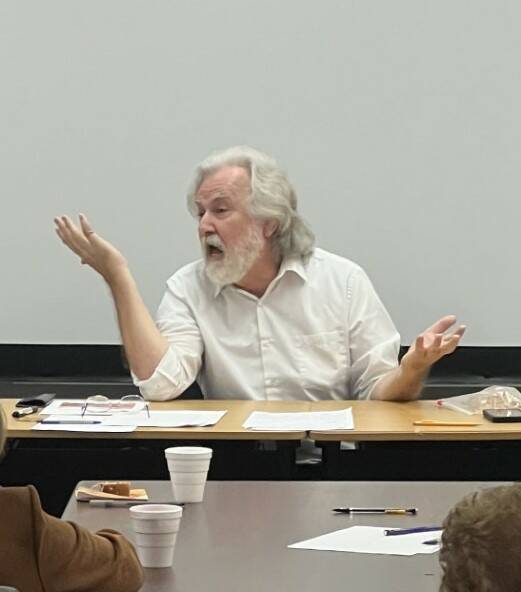
Dr. Daniel Rolph discusses one of many Indian folklore legends that are rarely found in textbooks.
Rachel Adkins/The Ledger Independent
Dr. Daniel Rolph recently presented a seminar on the Folklore and Myths of the Old West American Indians at the Kentucky Gateway Museum Center.
Rolph began his discussion by giving a brief background of himself. He said he used to present the folklore and myths of Indians when he taught academically for 30 years.
The “rationale” for Rolph’s “madness” is to combine material culture, historical and written knowledge, and legends and myths. He said he has always enjoyed this aspect of sharing folklore and myths.
“If you leave out an aspect of that, you don’t get the full picture,” Rolph said. He went on to share how his interest in folklore first began.
According to Rolph, he was always fascinated by Indians and heard “all kinds of” stories as he was growing up. He noted there are several oral traditions, myths, and legends.
The accuracy of the myths and legends as they go from generation to generation is not always reliable, he said.
“Sometimes they’re (the legends) right on the money, other times they lead you on a wild goose chase,” Rolph said. He shared an example that involved his great-great-grandfather and a misconstrued story regarding how he died and what war he died in.
Rolph continued to discuss folklore and myths in further detail.
According to Rolph, a lot of people tend to forget there was “actual” contact between the east, west, north, and south centuries ago. He noted oral culture’s presence does not mean there was never any physical contact.
When there are trade routes between groups of people, stories are often shared in communications. Rolph said migratory legends often result from these interactions.
He noted the term migratory legends is accurate to myths that have been heard all over, often in all 50 states of the nation.
Rolph went on to share a legend shared among Indians in America that could be considered one of the reasons their defeat came about.
“That’s something that people forget. One of the main reasons the Native Americans were defeated and altered was because of their own folklore, myth, and legends as to who they thought the Spaniards were,” Rolph said. He added the legends included the English and French as well.
According to Rolph, the Native Americans believed the Spaniards and other white groups were returning “white men.” He said there was a legend that portrayed them as white gods who had visited their tribes in the “far distant past.”
“By the time they’d realized they were cutthroats, it was a little too late,” Rolph said. He referenced smallpox as one of the effects of the group visits.
Rolph also discussed legends that involved mounds that closed after being entered, islands that have sunk in the sea, and various other topics.
He noted there are “all kinds” of traditions involving early Caucasians in the western hemisphere.
There aren’t many stories about the involvement of white people in history textbooks, according to Rolph. He said there are several instances where this kind of information can be found in scientific journals and documents created by paleontologists and other professionals.
Rolph suggested looking in the Journal of Canadian Anthropology for that kind of information.