

Eclectic arrangements including furniture, art and personal items are a highlight of The Isabella Stewart Gardner Museum in Boston, Massachusetts.

The Venetian garden is easily a visitor favorite at The Isabella Stewart Gardner Museum in Boston, Massachusetts.

An empty frame remains in place and marks the location of where a Rembrandt once hung before being stolen from The Isabella Stewart Gardner Museum in Boston, Massachusetts.
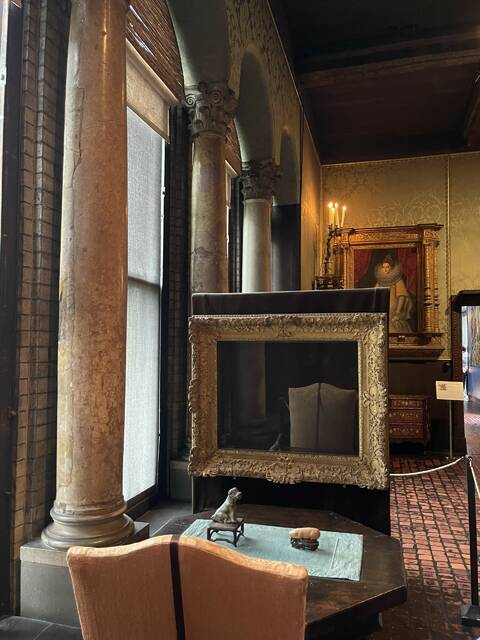
An empty frame remains in its original location at The Isabella Stewart Gardner Museum in Boston, Massachusetts, as a gesture of hope that the art will be recovered and returned.

Religious pieces, like this of Our Lady and the infant Jesus, are in abundance at The Isabella Stewart Gardner Museum in Boston, Massachusetts.
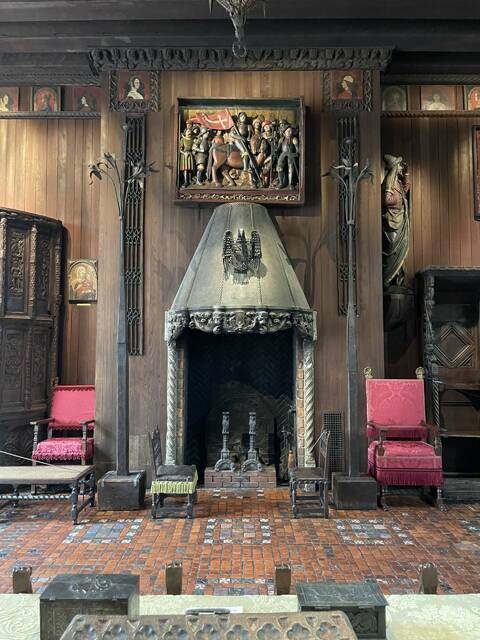
Several grand fire places are located throughout The Isabella Stewart Gardner Museum in Boston, Massachusetts.
It’s safe to say that each museum we visit yields an incredible experience. A unique experience. But when speaking of The Isabella Stewart Gardner Museum in Boston, Massachusetts, this description is beyond true.
Beautiful paintings, sculptures and other various works of art? They all have them.
Serene, picturesque gardens? Most have them.
Plaques accompanying the art? Plaques introducing the artists and providing insight into the art? Not at The Gardner.
Paintings, or possibly other works of art, displayed in frames hung on the wall? Not in every frame at The Gardner.
Thus, it is perhaps in what one does not see at the museum that most sets it apart from others.
Isabella Stewart Gardner, who lived from 1840 to 1924, acquired rare books, manuscripts and art from her travels to Europe and Russia and to Egypt and the Middle East. She and her husband, Jack, created the museum using inspiration from Palazzo Barbaro, a Venetian Palace.
The museum boasts several galleries, and at its center is a garden. Gardner’s life goal was to collect, from around the world, various works of art, to build a museum to house the treasures and to share her collection with the public. During her lifetime, she hosted concerts, lectures and exhibitions.
Upon her death, she provided an endowment for the museum’s operation but with the following stipulations: nothing could be changed in the galleries and no items could be acquired or sold from the collection.
Unlike traditional museums, no physical explanations accompany the art. This is Gardner’s stipulation, as she desired the museum to remain as she originally arranged it. Visitors are provided a museum map upon entering and are encouraged to use their own devices to listen to an immersive audio guide while walking from room to room.
And in some of the rooms, empty frames adorn the walls. On March 18, 1990, 13 works of art were stolen from the museum in what is referred to as the single largest property theft in the world. Three Rembrandts and a Vermeer were among the stolen pieces. To this day, the art has not been recovered, and a $10 million reward continues in place for information leading to its return. The empty frames, representing hope, remain hanging as placeholders.
In so many ways, The Isabella Stewart Gardner Museum delivers a truly unique experience. And watching the many visitors file through in mutual appreciation for what the museum features, and for what it does not, is an encounter we won’t soon forget.
(Note: Marjorie Appelman is a retired English, communications and journalism teacher from Mason County High School and co-founder of the travel blog Tales from the Trip, which is on Instagram and Facebook. She can be reached at marj.appelman@gmail.com.)