

Mount Rainier is an active volcano reaching 14,411 feet in height in Mount Rainier National Park, Washington.
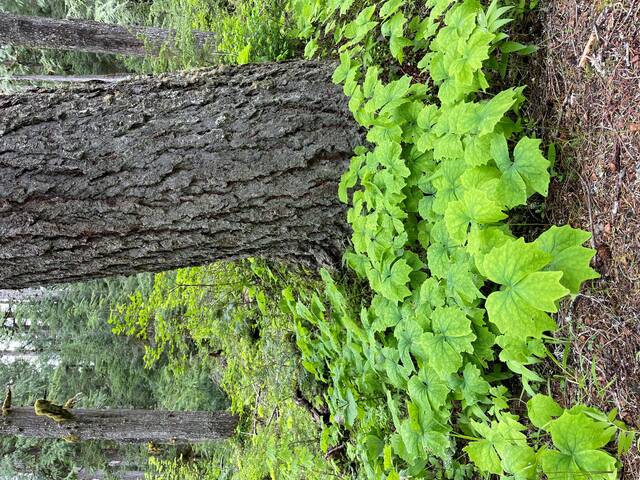
Forest growth at Mount Rainier National Park in Washington appears to float above the ground.

Snow accentuates the Cascade Mountain Range in Mount Rainier National Park, Washington.

Narada Falls stretches 168 feet and flows over rock and lava in Mount Rainier State Park in Washington.

Mount Rainier is visible for miles outside of Mount Rainier National Park, Washington.

Mount Rainier is visible between the trees near Kautz Creek in Mount Rainier National Park, Washington.
Enchanting.
That’s the single word, the single adjective that effectively encapsulates Mount Rainier National Park in Washington. Is it the only word? Of course not.
Beautiful. Crisp. Outerworld. They all come to mind as well. But when pressed for an overall descriptor, I return to enchanting. Final answer.
From the moment my husband and I pass through the southwest Nisqually Entrance, enchanting is the dominant impression. The first several miles into the park reveal a majestic forest of towering trees. Some thick with leaves, needles. Soft green moss covers the bare branches of others. Sunlight streams through the openings. On our right-hand side, the rocky Nisqually River accompanies the snaking, paved road. A blanket of broad leaves appears to float inches above the ground, dancing in the breeze or stirring from the movement of a passing car.
Kautz Creek is easily the first stop, as a clear view of the park’s snow-cloaked, namesake main attraction emerges through the evergreens. An active volcano that towers at 14,411 feet. The tallest mountain in the state of Washington.
Longmire, a village that dates back to the 1880s, is just a few miles further down the road. The National Park Inn and a general store are located here. It’s also the starting point for a couple of hiking trails. Additionally, and more importantly, it offers yet more spectacular views of Mount Rainier. So, we grab some snacks at the general store and secure a table on the hotel porch, where we continue to immerse ourselves in the beauty.
From there, Paradise Park is our next destination within the park. Bypassing a few noteworthy highlights, but allowing time to stop at each of these on our return to the park’s entrance, we venture down the road.
When we arrive at the visitor center there, we immediately notice that while the parking lot has been cleared, over six feet of snow remain around the main building. The area bustles with activity. Several congregate and snack at the picnic tables dotting the area. Others mill about on the snow.
Although there is much more to see beyond this point in the park, this is as far as time allows us to travel. This trip, anyway.
On our return to the Nisqually Entrance, we stop first at Narada Falls, which thunders under a stone walking bridge. From atop the bridge, we watch the falls tumble across the rocks and lava below before proceeding to the walking path. We follow the muddy trail as far as we can before it turns into a sheet of ice and snow.
The stop that awaits us next turns out to be the most memorable. After a short walk, we reach Paradise River. While the rocky bed is wide, only a modest but powerful flow of water rushes over the smooth stones. An inescapable pull to sit upon the rocks at the water’s edge overcomes us. Under the watchful eye of Mount Rainier, a crisp breeze stirs gently around us, reminding us, again, of the beauty and the majesty of this place.
Our return to the entrance only serves to reinforce our single-word descriptor of Washington’s national park: enchanting.
–
(Note: Marjorie Appelman is an English, communications and journalism teacher at Mason County High School and co-founder of the travel blog, Tales from the Trip, which is on Twitter, Instagram and Facebook. She can be reached at marj.appelman@gmail.com.)