
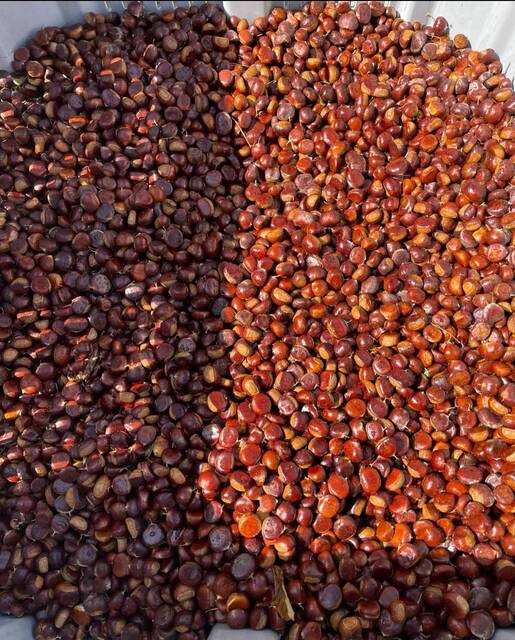
A bumper crop of chestnuts.
A bumper crop of chestnuts.
A grove of chestnut trees at the Mountain Gentry Tree Farm in Olive Hill, Kentucky.
Photos courtesy of Mountain Gentry Tree Farm
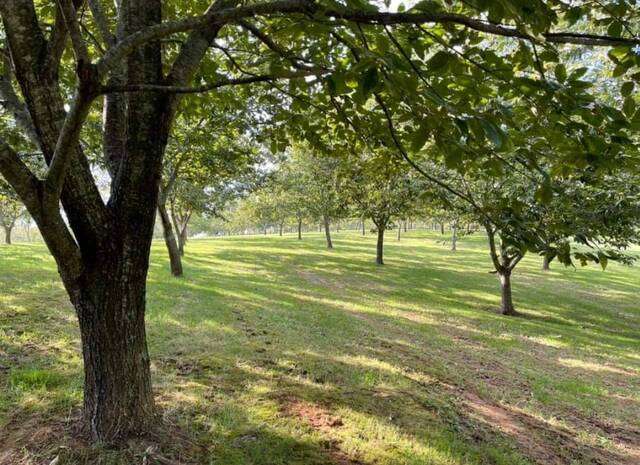
A grove of chestnut trees at the Mountain Gentry Tree Farm in Olive Hill
A bumper crop of chestnuts.
A grove of chestnut trees at the Mountain Gentry Tree Farm in Olive Hill, Kentucky.
Photos courtesy of Mountain Gentry Tree Farm

The site of 5,500 Chestnut tree saplings that were planted on Clark’s Run Road in Mason County.
The Ledger Independent, Karen Ann Hopkins
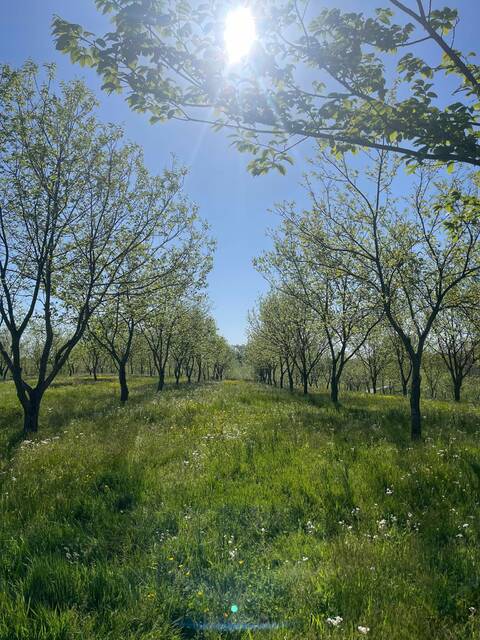
Chestnut trees grow into pretty shade trees that produce tasty chestnuts.
Chestnut trees grow into pretty shade trees that produce tasty chestnuts.
Photo courtesy of Mountain Gentry Tree Farm
MAYSVILLE—By the time the iconic Nat King Cole song, “The Christmas Song,” more often called “Chestnuts Roasting on an Open Fire,” was released in 1946, most of the American chestnut trees in the United States were dying of a blight that would eventually wipe out billions of them.
These giant trees dominated woodlands of the eastern portion of the United States from Alabama all the way up to Michigan, growing to 100 feet tall with trunks reaching 10 feet in diameter. In the fall, nutritious chestnuts blanketed the forest floors beneath their limbs, providing a feast for wildlife and people alike. The huge, straight trunks were used to make lumber for everything from building houses to railroad trusses.
Tragically, imported chestnuts from Asia brought a fungus to the American trees causing the giants that were once an integral part of our natural ecosystem to disappear from the landscape.
Forest rangers and conservationists say it’s the worst environmental disaster to ever strike our country and scientists have been working for decades to bring the American Chestnut back to life. From what officials say, although progress has been made, it may be a while before we know for sure if the efforts have been a success.
Luckily, there are many varieties of chestnut tree hybrid species that have prospered, producing larger nuts than their American counterpart which are just as tasty.
Agroforestry has been around a long time but is recently gaining popularity as people become more interested in creating carbon offsets for industries. The environment isn’t the only beneficiary when trees are introduced into farmland. Farmers are discovering that tree-growing systems have economic benefits as well.
You probably haven’t heard much about chestnut trees, but that’s about to change now that Mason County is the site of the largest commercial chestnut tree planting in the country. The trailblazing farm operation on Clarks Run Road will give local residents and farmers the opportunity to see firsthand how agroforestry works. This fall, 3,700 more trees will be added to the 5,500 already planted on the property owned by Keavin Hill. He’s teamed up with Mountain Gentry Farm, Propagate Ventures and Cargill in this uniquely beneficial project.
These particular chestnuts are rapid growers and produce a large nut that is a gourmet product. They’re also drought-tolerant and resilient to disease. Statistics show the nut market is expanding rapidly.
“There’s gigantic demand out there in Asia and Europe,” Gary Hater, the lead biologist for Mountain Gentry, said.
Hater explained the process, benefits and reasons for integrating chestnuts into croplands. “A farmer can plant trees in his fields and grow hay in the rows between the trees. Within 3 to 5 years, the trees will begin to produce nuts and he’ll still have the hay crop too. Once the trees grow large enough to shade out the grass, animals—like cattle or turkeys—can graze beneath the trees for several months a year. The residual nuts left after harvest are very nutritious for livestock.”
Matt Eusner, the owner of Mountain Gentry Chestnut Farm, added, “There’s no better place than Kentucky for chestnuts.”
Eusner believes we’re on the cusp of chestnuts becoming popular and that Kentucky is at the forefront of chestnut research and production.
“The conditions in Kentucky, especially the northern areas like Maysville are perfect for these trees to grow. We are seeing a superior quality of nut than from other places.”
The process gives farmland a dual purpose and once the trees mature — 15 to 20 years — and are at full production, they provide a lot of nuts. Eusner added, “You can harvest 2,000 pounds of chestnuts per acre and wholesale, they’re currently bringing $3 dollars to $5 dollars a pound. Retail, they sell for $6 dollars to $10 dollars a pound.”
Eusner said the variety of chestnuts being planted in Mason County has a large, sweet-tasting nut that’s uniquely edible.
“Most of the nuts that are now available come from Asia or Europe. Once they’ve traveled that far, the quality drops and they can develop mold.”
A slight roll to the land is preferable for planting these trees and the soil must be tested for the right PH balance. The Mason County grove’s testing results came back very favorably and planting began. Startup includes planting, tubing and mulching. State-of-the-art technology is utilized to mark the planting lines which depend on the size of the grove to be planted, the type of chestnut and the farm’s other uses.
Once the trees reach a certain size, they must be maintained through proper pruning and occasionally treating for Japanese beetles or weevils which are the tree’s greatest threats.
Sadly, when the American chestnut tree disappeared, so did a mainstay food in America. Chestnuts were an important source of nourishment for a lot of people. They tasted good and were free. Chestnut trees provided enough nuts to keep a family from starving during a long winter and Native Americans and African Americans regularly incorporated chestnuts into their cooking.
Chestnuts are fairly versatile nuts. They can be roasted or added to savory dishes or desserts. They’re gluten-free but can be processed into flour and used to make pasta or baked goods. For the health-conscious person, chestnuts are a perfect snack.
When asked about harvesting chestnuts, Hater said, “We’ve discovered that if they’re refrigerated for 3 to 6 weeks, the starch in the nut turns to sugar, making them even sweeter and perfect for culinary dishes. They’re big and sweet, perfect for stuffings, soups and other recipes.”
“I believe chestnuts are on the verge of going mainstream in America.” Hater noted, “They mix naturally with a backyard chicken flock and you can plant a few trees to a few hundred.”
Propagate Ventures and Cargill has the experience, knowledge and resources to bring alternatives to farmers with the goal of strengthening their farming operations. These companies make sure farmers are in a position to succeed by assisting with operational, business and financial risks.
Cargill’s Matt Schmitt said, “We design what works best for a farmer and their equipment. We want the farmer to be comfortable with the plan.”
This kind of agroforestry partnering is relatively new in the United States but has been around for a while in Europe and South America.
When a farmer enters into this business venture, they have a team of experts at their back and the resources to expand into new agricultural territories. These are usually 20-year leases which include a buy-out option or renewal at the end of the term. A farmer can expect to make between $150 to $250 an acre per year and still utilize the property for other farming endeavors.
Enthusiasm for the Mason County chestnut grove is high since it’s a launching effort to do more groves in the area. Recruitment efforts are underway and Schmitt said that farms consisting of 30 acres or more are eligible for consideration and can be assessed with soil and topography tests.
“We connect farmers’ produce with those who can use it,” Schmitt said. “We work out the points of friction for the farmer — mainly the high upfront costs — and structure projects to attract investors who are patient enough to wait for the trees to grow.”
The company currently supports approximately 75 farms and has 600,000 trees and shrubs on more than 20,000 acres across the United States.
Jeremy Kaufman, the COO of Propagate, said, “Agroforestry is expanding and we want to make it easier for farms to have the tools and information they need to succeed.”
Chestnuts and oaks are Mountain Gentry’s specialty, but the tree company assists farmers to pick out the tree that is best suited for their land and particular situation. Unlike apple or citrus orchards which are common and mass-produced in certain parts of the country, agroforestry projects tend to focus on the less common fruit trees. Mountain Gentry has started expanding into persimmons, swamp white oaks and even pawpaws.
“Our mission is to get more people to sign on to agroforestry,” Eusner said.
Besides their precious oxygen emissions and delicious, nutrient-rich fruit, chestnuts are beautiful shade trees that turn golden in the fall. Trees fight climate change and prevent soil erosion. They’ve also been proven to be good for health by reducing stress and anxiety. When you plant a tree it’s a gift to future generations — and with the largest chestnut tree grove in America, it looks like Mason County and local farmers are showing their commitment to the environment.
Mountain Gentry is located at 2333 Kentucky 1025, Olive Hill. You can reach them by calling 812-720-1968 or emailing sales@mountaingentry.com.
If you’re a landowner who’s considering agroforestry and would like more information, you can visit Propagate Ventures at www.propagateventures.com or Cargill at www.cargill.com.