
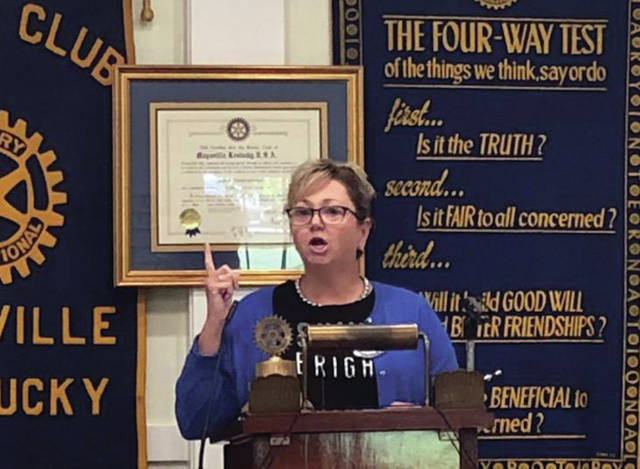
Mason County resident Stephanie Gastauer discussed the importance of recycling at the Maysville Rotary Club on Tuesday.
Gastauer said her mission is to educate people on recycling and the impact it can have on the environment.
“From the time we wake up to when we go to sleep, we make 35,000 decisions,” she said. “Every decision has a consequence. Some of them are intended and some are not quite so, but small decisions made consistently over time is what yields the biggest impact. My mission is to provide education so people will be mindful of what they purchase and what they purge.”
According to Gastauer, recycling has changed over the years.
“Before the industrial revolution, recycling looked quite different,” she said. “In the 30s and 40s, it was reuse out of necessity. Everybody needed to hold on and take care of their things. In the 1940s, goods were rationed. Post-war economic boom, conservation and reuse of goods became less necessary and we became a society of single-size, single-serve convenience.”
Gastauer said the original Earth Day began in 1970 and in the 1980s, the landfills took 150 million tons of waste per year. Today, we send approximately 100 million tons of material to the landfill.
“Recycling is not necessarily an economic issue as much as it is an environmental issue,” she said.
Gastauer also said recycling starts with the children.
“If you want to reach the parents and grandparents, you don’t start with the parents and grandparents,” she said. “This year, we sent home flyers that talk about where you recycle, who you can call when you need recycle, the materials that can be recycled, when recycle will be picked up.”
According to Gastauer, the City of Maysville has agreed to continue curbside recycling for the next 10 months of the fiscal year.
Gastauer said Mason County participation in curbside recycling is 14 percent, while the national average is 30 percent.
“Maybe it’s because of lack of education — I don’t know the reason, but I do know that when new people move in and go to the water company to turn on their service, they should be given information on how and where to recycle,” she said. “I think we make it difficult for people to do the right thing when we don’t give them the right information. My goal is to provide the correct information to make it easier for them.”
According to Gastauer, removing the curbside recycling program would make it more difficult for some people to recycle, because people with disabilities or lack of transportation would be unable to take their recyclables to the trailers.
Gastauer said she believes recycling will save money over time.
“We might not be making a whole lot of money, but I believe it will save us a whole lot of money in the long run,” she said. “It is a community-government partnership and we have our work cut out for us. If you will educate just one other person, that will create a ripple effect.”
There is now a Maysville Sustainable Coalition, which meets once a month at the Mason County Public Library, according to Gastauer.
“Recycling is only one piece of this puzzle,” she said. “Reduction and reuse is quite another. When we use reusable utensils, plates, cups — that’s a great thing. When you recycle your aluminum — it takes 95 percent more energy to create the aluminum than it does to recycle what you already have. So, take some time to think about what you purchase and what you purge.”
One person asked about the city commissioners comments about not being able to find vendors to purchase recycled items.
“I will say that that will be true in their eyes,” Gastauer said. “I think with some very savvy business folks, we can find some partnerships to do a better job on how we source those recyclables.”
Gastauer also said recycled materials going into the landfill is a misconception.
“Often times the material that goes into the recycle bins is garbage, so they have to go through the recyclables manually and what is left will go to the landfill,” she said.
According to Gastauer, items that can be recycled include cardboard that is broken down without wax coating, magazines, newspaper and other paper without staples, green, brown and clear glass, number 1 plastics (water, juice and soda bottles), number 2 plastics (laundry detergent, milk and shampoo containers) and aluminum and metal food cans.