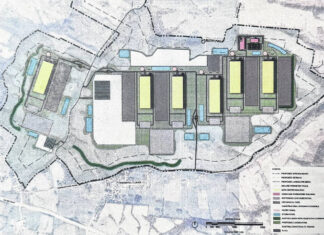

After two readings, Ordinance 26-01 has been officially adopted, placing regulations on data centers as law in Mason County.
On Friday, Feb. 27, the Mason County Fiscal Court held a special meeting for a second reading of Ordinance 26-01, which regulates data centers in Mason County.
Some of the highlighted points within the regulations included changing the residential setback from 500 feet to 750 feet, re-instating a separate setback for sensitive uses at 500 feet, an exception to the 75-foot height restriction for electrical poles and fittings not part of a data center structure, lowering the daytime noise level to 50 dB(A), stating that generator testing is allowed once a week and must comply with noise requirements, and stating that construction noise must comply with noise requirements.
During the meeting, Mason County Attorney John Estill clarified that this ordinance is intended to permit data centers in the I-3 zones, “not outlaw data centers in Mason County.”
“Balancing that from the Planning Commission was to have some robust protections for citizens and particularly neighboring property owners, and this is an attempt to balance those in keeping with what the Planning Commission recommended,” Estill continued.
After discussing the changes made after the first reading of the ordinance, Mason County Judge-Executive Owen McNeill applauded the members of the Maysville-Mason County Joint Planning Commission (JPC), Estill and his staff, and everyone else who contributed to the current ordinance as it stands.
“I am pleased with the added protections of 750 feet. I know that has been on all three of the commissioners’ minds. I am, I’m pleased with the construction ordinances,” said McNeill. “And just being a good neighbor, only doing construction while the sun is up. Here in Kentucky, we generally stick to that, stick to that theory.”
He noted that he had received a letter from the state’s task force on artificial intelligence and data centers.
“If you think back over the last two years, Maysville and Mason County and our region has been somewhat leading the way for the Commonwealth of Kentucky after the legislators even made it remotely possible for these things to operate here,” said McNeill. “Their recommendation off that committee mirrors a lot of what we worked with 18 months ago with our friends with East Kentucky Power. I am proud of the fact that a lot of the ideas that are generated here, you’re starting to see gravitate nationally with regulating these things.”
Mason County Commissioner Chris O’Hearn thanked the JPC, Estill and McNeill, stating, “This is a tremendous amount of work… and for listening to folks and addressing some of these concerns. You know, I know some will look at it and think it’s not perfect, but in a county of 16,000, it’s never gonna be perfect for everybody, but I do appreciate all the work that’s been put in and the thought process.
“I think at the end of the day we have to decide, you know, our votes are what’s in the best interest of this county moving forward, and there will be construction headaches, there will be some headaches that we’ll have to work through, but at the end of the day, is this project in the best interest of Mason County? And in my opinion, I believe it is.”
Mason County Commissioner Joe McKay also thanked the contributors, as well as the Industrial Development Authority and Tyler McHugh, Executive Director of the Maysville-Mason County Industrial Development Authority.
“Every little city, town, county throughout the country is looking for jobs, industry to come to their area, and we’re at a crossroads here, I mean, growth, just simply growth, how do we grow where is Mason County now, where do we want it to be in 25, 30 to 40 years from now, and how do we get there responsibly?” expressed McKay.
In a letter by Kentucky Senate President Robert Stivers, McKay stated that he agreed with him on the topic of economic impact, as well as that the impact from a data center “is going to be significant.” He then expressed his belief that there could be a ripple effect, with companies being drawn to the area, resulting in benefits for schools, increased revenues and education.
“I’ve always thought the possibility of this would do that: attract additional investment, and not only additional investment, but to the local economy, to the small businesses, the restaurants and tourism,” said McKay. “People keep asking, ‘Why Mason County, why Mason County,’ and my question is ‘Why not Mason County? Why not Mason County if it’s done responsibly?’
“We’re here to weigh both sides. I mean, change is hard, change is hard, growth is, I mean, but we’re gonna grow, we’re gonna grow one way or the other, either by chance or change, it’s just that simple. This data center, considering this is not a dismissal with the concerns, but it’s a commitment to move forward responsibly, in my opinion, with enforceable conditions that’s been set forward. Clear operating standards and ongoing oversight to protect our community. I just think it brings a great long-term benefit to Mason County, basically for the greater common good for the community and its citizens.”
Mason County Commissioner Peggy Frame also thanked the ordinance’s contributors, stating, “We’re just gonna have to see how, I think a data center’s a good opportunity as long as it’s done in the right way, and we shall see about that. I really appreciate everything everyone’s done, and because it’s been a lot of hard work and a lot of negative, positive thoughts from everybody, and we’ll just have to move forward and see where it goes.”
McKay made a motion to approve Ordinance 26-01 as adopted, with a second made by O’Hearn. A roll call vote was taken with four yes votes, unanimously passing the motion.
At the end of the meeting, resident Julie Burton asked to speak.
During her address, Burton stated, “None of the changes announced today, Feb. 27, have addressed protecting prime farmland or land of statewide importance fully as stated in our comprehensive land use ordinance. I know you’re saying 2,000 acres, we know it’s gonna be more than that, we’re pretty sure, okay. And plus, the 4,000 acres of solar on farmland in Mason County or Mays Lick. Health effects of data centers haven’t been addressed.
“We need to know if you’re going to announce when a permit has actually been requested; you know, since you’re approving this. I would like to request that the environmental impact studies and community impact studies be released to the public. And I do appreciate JPC, but there have been a lot of individuals who researched this, too, and a lot of our research would preclude even entertaining the idea of data centers on farmland.”