
A program to help the community better understand what life is like for a person recently placed on parole or probation was held on Tuesday at the Mason County Steam Academy.
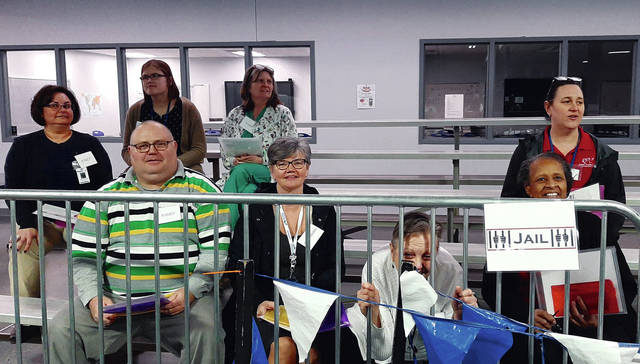
At 11 a.m. and 1 p.m., community members and business leaders were invited to take part in a simulation where they were each given a scenario and had to spend the hour living their life as if they were that person.
Each scenario involved a person on probation/parole and the tasks that had to be completed within a “week” which was only 15 minutes long.
The stations available to visit included family support, super center, probation and parole, employer, ID station, plasma, discount medical, treatment/counseling, quick loan/pawn shop, career center/GED, food stamps/rental assistance, vocational rehabilitation, social services, SSI/disability, drug testing, church, AA/NA, food bank, clothing closet, homeless shelter, rent/utilities and transportation.
“They have four “weeks” they go through,” Michelle Chism, with the Kentucky Division of Reentry Services, said. “Each “week” is 15 minutes long. They have a series of tasks they will need to finish during each “week” and if they don’t complete them, they’ll go back to jail.”
The tasks included paying rent, checking in with their probation office, going to work, among other things.
Each task had to be prioritized, according to Brittany Corde, with Workforce Development.
“For example, before they can go and get resources, they have to go to the ID station and pay for an ID before they can get an apartment,” she said. “So, if they go somewhere else, they might not have the money to get an ID, so they can’t get a job.”
One participant, Hazel Graham, portrayed a person named “Justin” who served 20 years in federal and state prison for murder and felony firearm possession. During the day, “Justin” was sent back to jail for testing positive after drinking alcohol.
Graham said after going through the scenario, she understood more of the frustrations people who are on parole/probation go through each day.
“I work for drug court, so I wanted to get a sense of what my participants go through,” she said. “It’s very frustrating and confusing. You try your best and it seems like there are so many obstacles in the way. You have to have transportation to do anything and money, so it’s hard. It’s not easy.”
After finishing the simulation, Chism had everyone sit down and discuss what they learned from it.
Several people said they were frustrated during the simulation, because they never felt like they had the time to finish anything, the requirements were unclear and there were issues with money and transportation.
“So, our justice involved individuals who are released daily, do you think they have barriers to face? That they go through this everyday?”she said. “I heard some of you say ‘just put me in jail.’ Do you think it was easier to just go to jail than to complete all of these tasks?”
Some other issues discussed were how many people being released from jail will have to return.
“In real life, it’s even worse,” Mason County resident Bryan Helphenstine said. “In real life, between all of these things, you have using friends, drug dealers, liquor stores, dysfunctional parents and significant others.”
Chism said her hope for the program was to have people understand what it is like for people involved with the justice system.
“I just hope people give justice involved individuals a second chance and they help break down these barriers, so these people can be more successful,” she said. “Just because they’ve committed an offense or gotten into trouble one time doesn’t mean it should bar them for the rest of their lives.”
Leave a Reply