
Diners lounge beneath two generous umbrellas secured outside a restaurant, while others in the piazza stroll across the aged stones and disappear into the maze of narrow passageways between buildings.
Across from our hotel, three residential stories rest atop the ground-level shops, modest foliage lining random balconies of the white-trimmed apricot structure.
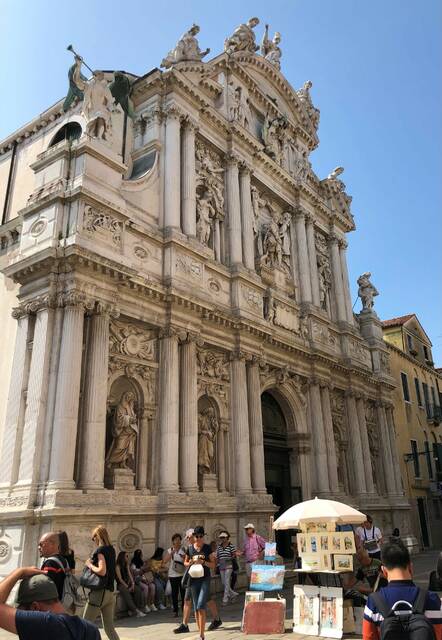
To our left, a handful of shoppers pore over merchandise at a small kiosk adjacent to what must be a church. While the side visible to us is nondescript, my husband and I can make out the forms of winged statues protruding from atop tall columns.
We are not surprised to see a church within a stone’s throw of our hotel, as there are close to 200 churches in Venice, Italy. And although it isn’t on our list of places to explore, we decide it warrants a look due to its proximity to us.
In the mornings, we pass by this church and note its striking yet unusual facade. In the evenings, we pass by this church and note how the floodlights further enhance its striking and inviting facade.
But what, exactly, is its appeal? Why is it capturing our interest? And why do we feel so drawn to discover the source of its attraction?
The multi-level facade is adorned with various statues dotted with cherubs and separated by columns. Impressive and commanding as a whole.
But when we place our attention on one particular statue, more questions arise: why is the figure holding what looks like a telescope? Or is that perhaps a rolled up map? What saint could that possibly be?
As it turns out, the Church of Santa Maria del Giglio was founded in the 9th century, but much of what we see today is the result of reconstruction efforts, funded by Admiral Antonio Barbaro and his family, in the 1600s.
What is not unusual about the church is that Barbaro commissioned the reconstruction, after it burned twice, to glorify Mary. What is unusual is that he also dedicated the remodeling to honor himself and his brothers and their military and political careers.
This is best manifested in the facade.
The facade, designed by Giuseppe Sardi and built between 1678 and 1683 features statues not of saints, but of Barbaro and his brothers.
As ornate as the exterior is, so too is the interior, which features additional statues and elaborate paintings. The “Way of the Cross,” the “Four Evangelists” and “The Virgin Mary and Child with the Little Saint John” are just a few. Even the ceilings are decorated with large canvases depicting the Birth, Coronation and Assumption of the Virgin Mary. Most of the paintings are credited to Venetian artists.
(Note: Marjorie Appelman is an English, communications and journalism teacher at Mason County High School and co-founder of the travel blog, Tales from the Trip, which is on Twitter, Instagram and Facebook. She can be reached at marj.appelman@gmail.com.)