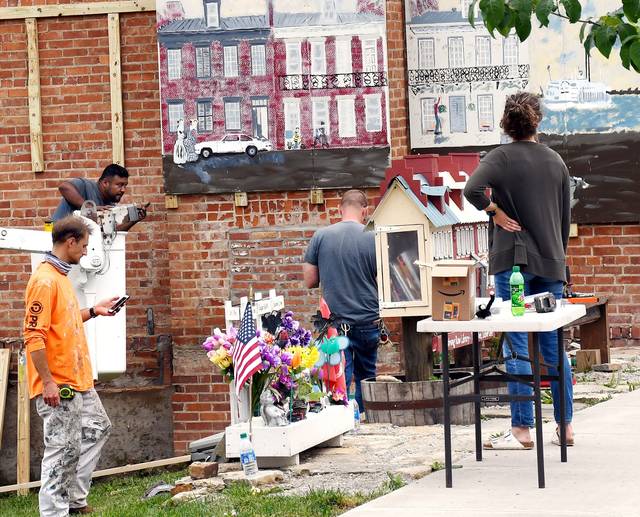
David Darmitzel, in the orange shirt, and city workers Ernesto Garcia and Richard Heber install the Armstrong Row panels.
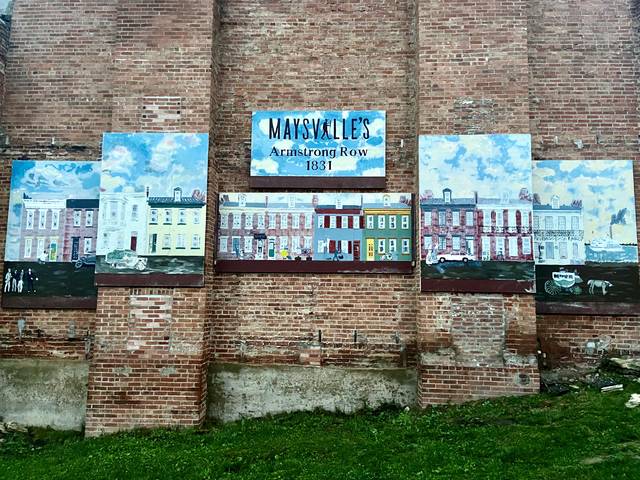
Call it a tribute to Maysville, or to the historic rowhouses he and his family called home for several years or a parting gift to his adopted city.
Whatever you can the mural project David Dalmitzel, his family and friends created and installed recently on his neighbor’s home, it is certainly an eye-catching piece of artwork.
“It was just something I felt was right to do,” Darmitzel said.
The murals hung along the side of the home of friend Charlie Haughaboo at 215 Second Street depict the historic 200-year-old homes that make up Armstrong Row.
Haughaboo approved.
“Doesn’t it look good,” he said.
Armstrong Row is a series of brick row houses on Second Street in Maysville. They were built between 1820 and 1833 by John Armstrong, a local industrialist, entrepreneur and real estate developer.
Today, the row houses are notorious for a 2015 fire that took the life of Lori Doppelheuer, who died trying to rescue her children, three of whom also died in the fire. The fire also claimed the life of 68-year-old Larry Brickels, who lived in another of the row houses.
Today, green space occupies the site of those row houses destroyed in the fire.
Darmitzel and his wife Sarah, moved to Maysville after the fire but the couple was still touched by the event, he said. He always wanted to do something to “beautify and honor that space,” he said. The idea of the mural was born from that.
With help from family and friends, Darmitzel went about the task of gather photos of the row houses, adjusting the photos to remove any distortion and straightening the picture to show a true depiction of the Armstrong Row. He also received some help from Orloff and Elizabeth Miller.
The photos were then projected onto the panels of the mural and then art project was underway.
Once completed, city workers including Ernesto Garcia, Roger Hodges and Richard Heber stepped in to put the murals into place.
The result is a public art display that depicts the row houses throughout their history with meaningful symbols intertwined. Four men drawn in one corner of a panel are actually the four responsible for financing the original construction project. Another shows a white Chevy Vega is front of the row house where the Dalmitzel family lived, a nod to the only photo they could find of their home which included a 1980s Vega parked in front.
In yet another place, two dogs that were lost at Cummins Nature Preserve while the family was hiking with friends and later found are depicted.
And in front of the house where Doppelheuer and her children perished is a military vehicle, a tribute to her service in the Marine Corps. The symbol was approved after consulting with Doppelheuer’s mother, Ann Shumate.
Although Dalmitzel and his family have moved back to Missouri for his wife’s work, he said the family is keeping their Maysville home and turning it into an AirBNB. He said they plan to return to Maysville several times each year.
The beauty of the region and the historic buildings that dot the area made quite an impression on Dalmitzel. He hopes those who call it home appreciate what they have and make an effort to preserve the past.
“I think Maysville is so beautiful,” he said. “It could be anything it wants to be.”